Saturday, November 17, 2012

Social Enterprise Seminar - Fall 2012


Social Enterprise Seminar 2012.

Held at the Creekside Community Centre Vancouver in Fall 2012, the seminar attracted a group of Rose Charities enthusiasts and supporters with wide interests and areas of involvement.  Rose Charities organizers believe very much in sustainability and local support and involvement for all projects and one way to achieve this is to incorporate social enterprise components wherever possible.

The meeting spanned initiatives both at the donor end as well as the field project end, as well as those which bridged both.  Moderated by Rose International Members, Linda Roberts and Will Grut, the keynote speaker was Margaret Mason of Bull Housser who outlined some of the basic and most important aspects of social enterprise projects.

From the Vancouver end, the 'Lot To Give' and 'Give Group' programs were presented by Laura Benson and Kris Roberts respectively  In principle these are based around the concept of supply of a service either online or through other sources or retail outlet with significant focus on charitable donation.  With Give Group this is through real-estate transactions.

From the field, projects presented included Rose Vietnams paper flower making at Than Thien Village, a centuries old historic art which Rose Vietnam has been helping to revive.  Beekeeping in coordination with the Bee World Organization in Zambia and Cambodia,  brickmaking in Uganda with Dr Andrew Macnabs Brighter Smiles group, and volunteer tourism and elective student field experience trips in Cambodia.  Lawrence Keenan, continually one of the main project instigators and supports in Sri Lanka, outlined the current social enterprise initiatives there, including the amazing  Rose Sri Lanka microcredit program and other initiatives embracing health and food distribution.

Janine Vertone's initiative (Ukama Arts) of import and sale of Zimbabwe sculptures , with much of the proceeds being returned for Zimbabwe school support is a project which links both the field and the donor end.  The honey projects mentioned above also fit into this category as the Honey Bee Centre in Surrey will, if possible, purchase and import any honey not sold locally through its international projects.  Finally Malambo Grassroots in Zambia also has several womens groups who produce handicrafts, some of which are sold in Vancouver

Following presentations were discussions on some of the challenges the projects faced, how they were planned and established as well as future projections.  Interchange of ideas was beneficial and interesting and groups came away with new ideas for further development of plans for their areas.

Refreshments were kindly supplied by some of the participants (thank you Linda Roberts) and there was general agreement that the seminar was both beneficial and interesting, and should be repeated in 2013.


Saturday, March 10, 2012

We pay tribute, one year on, to those who helped Tohoku...

11th March 2011:  Around 3.30 pm tsunami hits the Tohoku region of Japan.  20,000 people die; the region is utterly devastated..

The directors of Rose Charities and AMDA Canada pay tribute to...

The AMDA Japan emergency relief teams who were in the region within hours of the disaster.  Day by day more AMDA personnel, nurses, physicians, logisticians, counselor teams were sent to the area who fanned out into all the affected regions to provide emergency relief, shelter and support.  At the same time tons of materials, supplies from all over Japan were shipped in by the truckload

The AMDA relief work still continues, now more in the form of community rehabilitation, school assistance and health clinics

The people of Vancouver, Steveston, and Richmond BC. who, through two fundraisers partly  assisted by Rose Charities Canada and AMDA Canada, as well as a general appeal contributed some $85000 to the AMDA relief efforts. These included  $10,000 from the Johrei Fellowship, Richmond, and over $19,000 from Aero Trading Co. Ltd. (aerovan@aerotrading.ca). A fundraising dinner put on by CIEAF, Stevesdon Community Center, Steveston Buddhist Temple and Kayama Enterprises Ltd, raised $35000 (see photo right).  A second fundraiser,  including sales of photographs donated of the Tohoku region,  put on my Ms's Mari Myiasaka and Tsuneko Ishii and sponsored by the Fraser Magazine (www.thefraser.com) raised around $15,000

The people of Sechelt and Sunshine Coast .B.C. who, though a beautifully organized fundraiser partly by the renowned Garden Bay artist Motoko  (www.motokoart.com ) raised around $15000  for both the Red Cross and AMDA relief efforts

The UK Shiatsu groups (many) and  Shiatsu Society UK  who donated generously via Rose Charities UK to the AMDA relief effort

To all you people who rose to assistance of the suffering of the people of the Tohoku region in Japan, we thank you. Your generosity will not be forgotten.


And to the people of Tohoku:  we salute your quiet bravery and your dignity.  It is almost impossible to imagine  your losses, but we are with you and will remain with you in our thoughts.  You are inspirational in the visage that you have shown to the world in this terrible time. 


Wednesday, February 1, 2012

Nine things board members could do to help raise funds

Here are 9 things you could ask your fundraising-shy board members to do:  by Nell Edgington

Help create or evaluate a business plan for an earned income venture. If you have business leaders or entrepreneurs on your board this would be a great use of their time and add tremendous value to your organization. If they can help you create a more profitable business, they are directly contributing to your organization’s bottom-line.
Advocate for government money. You may have a board member that can’t stand the idea of asking their friends for money, but they are well connected in city, county, state or federal government and could open doors to you for government contracts, grants, fee-for-service or other government monies.
Provide intelligence on prospects. If you have a board member that seems to know everyone in town, but for whatever reason refuses to ask any of them for money, they can still be incredibly useful. You may be getting ready to ask a prospective donor for $1,000, and this board member can tell you what that person has already given to, at what level, who else might know them and so on. When you make an ask, the more information you have going into it, the more successful you will be.
Set up a meeting with a prospective customer. If your nonprofit is engaged in an earned income venture, you probably always need help with new sales. If you have a board member who is part of, or connected to, the target customer(s) of your business, they could open doors to new customers. Or at the very least, they could help you think through your sales and marketing strategies and make them  more effective so that you can attract more customers.
Email, call or visit a donor just to say thanks. The stewardship of a gift is an often forgotten, but incredibly critical, part of the fundraising process. According to Penelope Burk’s annual donor survey, 84% of donors would give again if they were thanked in a timely way. And being thanked by a board member is a bonus. A donor who renews their gift to a nonprofit is providing more money for the organization.
Explain to a prospect why you serve. A board of directors is a group of volunteers who care so much about the mission of the organization that they are willing to donate their time (a precious resource) to the cause. As a donor, it is affirming to see that a volunteer is contributing time, but it is even more motivating to hear, in the board member’s own words, why they feel compelled to serve this organization. That story can be enough to convince someone to give.
Host a small gathering at your home. Over the course of a year, most people invite a gathering of friends and/or family into their home at least once. A board member could take a few minutes at their next dinner party, birthday celebration or Super Bowl feast to talk about something that is near and dear to their heart: the nonprofit on whose board they serve. They don’t have to ask people for money, But they could simply say, “If you’re interested in learning more, let me know.” And then the nonprofit’s staff could take it from there with those who are interested.
Recruit an in-kind service. If a board member could remove an expense line item from a nonprofit’s budget that would directly contribute to a stronger bottom-line. For example, if a board member works at an ad agency, could they convince their company to provide some pro-bono marketing services to their nonprofit? But keep in mind, these in-kind donations must be of value to the nonprofit and provide an offset to a direct cost that the nonprofit would otherwise have to bear.
Negotiate a lower price from a vendor. Do you have a board member with great negotiating skills (think of all of those lawyers on your board). Could they negotiate with your insurance providers, office space rental company, or printers, for a lower price? If so, that’s more money in the bank.
If you think of a board member’s “get” responsibilities in these much broader terms, then I find it difficult to imagine a board member who cannot bring money in the door. You just have to get strategic about how each individual board member can best contribute to the organization’s bottom-line.

Sunday, January 22, 2012

Rose Charities International Meeting: Progress update Jan 2012

Rose IV Meeting and Conference: Penang :  Update Jan 2012

The Rose IV Meeting in Penang, Malaysia (22nd to 25th March 2012), and hosted by the Penang Rose Charities Association (Rose Charities Malaysia)  is shaping up to be an amazing gathering of both Rose Charities , and other people the world over.

Delegates representing projects or registered Rose groups from,  Australia, New Zealand, Singapore, Malaysia, Cambodia, Vietnam, Sri Lanka, Pakistan, Afghanistan, Uganda, UK, USA and Canada and Guatemala  will be attending.  

The ‘Hillman Fund’, a special group inside Rose Charities Canada which sponsors health education projects in Africa, Pakistan, and Cambodia will have a big presence including chair of the Hillman Committee, Dr Joanne Young of Vancouver,  Annette Borkent of the Safe Motherhood Guatemala Project, Dr Wagma Reshsteen of Primary Health Frontiers, Pakistan, and Dr Wais Aria of  The Tabish Social Health Organization, Afghanistan.

Dr Andrew MacNab (B.C’s Childrens Hospital)  founder of African Hearts and Brighter Smiles, Uganda will be speaking on his work with Health Promoting Schools, and Rachel Green of Rose Charities USA on the topical area of Social Networking.

AMDA International’s senior Emergency Relief Director (Mr Nithiananan) will be attending (AMDA and Rose Charities have worked very closely a number of  emergency relief operations and are very close partners) . AMDA has huge international emergency humanitarian relief experience, and is one of the foremost NGO’s in this area.

Joanna Thomson, founder of the Rose Cambodia Rehab Center will be discussing her amazing assistance to the disabled of Cambodia,  Mr Louis Lap Nguyen co-founder of Rose Charities Vietnam,  the impressive range of Rose Vietnam projects with include sight restoration, income generation and orphanage assistance

Rose Charities Sri Lanka with its spectrum of multi-sectorial projects, ranging from early childhood care and education, through education for all ages, including college support, micro-credit, sports for peace and vocational training will be represented by co-founder Mr Anthony Richards as well as Dr Yoga Yogendran.

From Rose Charities New Zealand, Mrs Anne George will be representing. Rose New Zealand works closely with the Rose Cambodia Sight Center providing expertise and resources. In 2011 the Sight Centre passed the mark for patients assisted (many with sight restoring operations). Rose NZ also assists eye programs in Nepal and work in NZ itself (Anne Georges specialty) with new immigrant program(s).  Rose Australia delegates will include Sarah Miller, an expert in Cambodia programs, Rose Austalia’s main focus.

Rose Charities Malaysia, the hosts will be very well represented, not least by Mr  Lawrence Cheah Chair of the Rose International Council.  Rose Charities Malaysia, running out of Penang assists Malaysias indigenous people (Orang Asli), help the aged programs and helth promotion in Penang.  

The meetings will work at three levels.  a) sector focus groups on specific areas (Vietnam, Cambodia, Sri Lanka,  and Health Education/Safe birthing etc ) , round-table discussion for the whole Rose network and a more formal Conference component where persons from Malaysian (and other) NGO’s and interested parties will be invited.

Malaysia’s Penang Island, with its historic UNESCO listed George Town, is a wonderful location for the meeting, most of which will be held in the seaside Tanjung Bunga area at the Paradise Sandy Beach Hotel.

All Rose Charities persons and other linked or interested parties are welcome.

For details, please contact Mrs Sarah Miller (Australia)    sarah@rosecharities.org.au
                                      or  Ms  Judith Peralta (Canada)     jbperalta@hotmail.com    


* Note: with one or two exceptions where limited assistance has been offered, all attendees are self funding.  Conference costs have been kindly born by Rose Charities Malaysia from specifically donated sources.  No Rose Charities charitable donation funds have been used for the conference or meeting, unless specifically given by donor(s) for that purpose.    


Thursday, January 19, 2012

Health Promoting Schools Conference Nov 2011: a grateful student kindly writes

Learning Outcomes from Many Voices One Song Colloquium
I would like to thank the Hillman Fund for their support for allowing me the means to attend the health promoting schools colloquium at Stias. With your support I was able to present regarding my experiences working in health promoting schools with Brighter Smiles Africa this past summer in Uganda, another project the fund kindly supported. This colloquium was the first time that I have the opportunity to present at an academic session and there are indeed many lessons that I have learned. It was  also nice to be reunited with one of the Ugandan students I had worked with in the summer.
Learning about other models of health promoting schools currently being implemented was very interesting, especially as we were learning from the very people who created them. Aside from the successes that were described, the sessions also provided healthy discussions of the challenges and obstacles that the different programs have faced and the approaches that were taken to solve some of the roadblocks. Key lessons that came up over and over again included:

·       The importance of creating relationships with communities prior to initiating projects.
·       Really listening to what is being asked for
·       Having local buy-in within communities and champions who are willing to run projects
·       Having a clear entry and exit strategy so that projects are created in a supportive and sustainable fashion 
·       Having a willingness to learn from communities and to be flexible. This can allow projects to evolve
·       How patience and persistence are critical to success in navigating complex bureaucracies

I was quite inspired by the different people that I met at the colloquium. There was such a diverse mix of professionals ranging from physicians, dentists, nurses, educators, social workers, psychologists, anthropologists, psychologists, students and politicians. Even more fascinating was the diverse collaborative roles that many of the participants had; for instance, to see a physician involved in front line education, policy making, and community development while also running a practice and having a rich personal life was vital for me to see. This alone expanded the way I view my role as a future health care provider.

Stepping back from my studies for a week to take part in this conference helped me see the bigger picture. This colloquium also helped me to create links and gain an understanding of how ideas get created, and the paths they take to get implemented. Listening to stories of success and failure taught me the importance of persistence and patience when working with bureaucracies. More importantly, this event impressed upon me the significance of collaboration - not only among colleagues and other professionals but also with members of communities – in dealing with social and health care issues.
On a personal level, I was touched by the support and encouragement that was shown to me. Prior to going, I felt as though I was just a student going to present to other professionals, but I was wrong. Throughout the entire conference I was treated as a colleague and it was an honor to be respected and heard. This experience taught me that as a student, I represent the future, and that I can have a role in helping to determine how individuals, communities and governments work in dealing with social issues.   

Participation in the colloquium has also planted seeds for future international discussion and collaboration between the students present; the chance to contribute to a consensus statement on the future of Health Promoting Schools; and an invitation to submit a joint paper to a focus edition of the journal Health Education to be dedicated to the work presented.  

Lastly, I would like to emphasize that the mentorship and guidance shown to me by Dr. Macnab and his colleagues is a precious and lasting gift that I deeply cherish.

Thank you
Sincerely

Mohammad Bardi    

Thursday, December 15, 2011

Rose NZ, Poonga and Christmas

Dear Fellow Rose Trustees

I want to tell you all about my visit last night to the big end-of-year event for the Poonga- Tamil Community Education Group which we have donated to over the last five years.

It really was a most sparkling and heart-warming event, with lots of children involved from pre-schoolers to tertiary students, all there in glittering costumes or beautifully presented saris, with parents and volunteer teachers. Obviously a huge amount of work goes into the children's performances, training that has gone on every Sunday when Poonga meets throughout the year.

 The stated philosophy is "to integrate with the mainstream" while also trying to keep the Tamil language and culture alive. For the first time the early childhood group, dressed in paper cutout "puipuis" , did a Maori action dance, as well as their own cultural dances.  It was a joy to see --- and the kids obviously loved some of the eye-rolling, tongue- poking moments. Anne , who has just finished her Early Childhood Diploma to add to her other professional qualifications in social work trained the kids for the Maori dance, as on the NZ curriculum, Te Whariki.

There is no doubt Poonga does a marvelous job of supporting the Tamil families it is involved with on five levels--- pre school (where 63 children are enrolled); Tamil language teaching; Bridging School, which links the children to the NZ curriculum ; examinations conducted in Tamil through Australia and internationally from Year 1 to 10;  and a parent group which offers first aid and health programs.


Best December wishes again---more coming!

Sunday, October 9, 2011

Rose Australia 'trivia-night' fundraiser, big success...


Edwina Bower
Some  80 people came to enjoy Rose Charities Australia's 'trivia-night'  planned and organized by Edwina Bower, and Penny Kendall and assisted by family members Will and Philip, on Friday 7th October 2011.  Held at the Willoughby East Bowling Club in North Sydney, participants enjoyed a lavish barbecue, and home made cakes and treats prepared by Edwina and her family.   Edwina visisted Cambodia last year and with brother, Will helped Joanna Thomson's Rose Rehab project at Chea Chumneas hospital assisting with much valued administration.

Penny rolling comp in background
Apart from the meal, drinks and trivia quiz (around 50 questions), other competitive events were included, such as paper aeroplane distance flying, and penny rolling.   The evening was hugely enjoyable and raised several thousand dollars for Rose Rehab Cambodia
Penny Kendall

Paper aeroplane competition

Tuesday, September 27, 2011

Instruments needed for Zambian kids

27th September 2011.  Malambo Grassroots is collecting musical instruments for their kids music project in Zambia.  They will be shipped within the next month by container to Zambia

Malambo runs education, school(s), health, community income generation and other community projects in the Monze area.  Two thirds of Zambians live on under $1 per day.

If you have any musical instruments you could donate, please email:  contact@rosecharities.ca

Saturday, September 24, 2011

New member for Rose Cambodia Rehabilitation Centre...


Introducing Leang Khy! Our new trainee physiotherapist, now working part-time with us and soaking up the skills and experience of Sokny. This is a new program we are implementing in an effort to further bridge the gap between NGO and Government health service provision and education. Leang Khy is a Cambodian trained physiotherapist (Diploma of Physiotherapy from the Technical School for Medical Care) employed by Chey Chumneas Referral Hospital, but like so many physiotherapists in this country, she was not actually working as one. Instead, she works in the pharmaceutical department distributing medicines. There has previously been no government physiotherapy service functioning in this hospital.

With the Hospital Director's support and permission, we are now supplementing Leang Khy's (small) monthly government salary, and providing her with training to work as a physiotherapist within the hospital. She is motivated, enthusiastic, and showing great promise. Her limited, but very much improving, English is adding to the speedy progression of the Khmer language skills of foreign staff!

Leang Khy has been a wonderful, vibrant addition to the work place since commencing with us in August.

Here she and Sokny are pictured working with a stoke patient, utilising our new blood pressure monitor, purchased with funds from CIDA.


Sokny is doing an amazing job taking Leang Khy under his wing, patiently teaching, listening, demonstrating and working collaboratively with her to improve rehabilitation services for patients at Chey Chumneas Referral Hospital.

At this stage, Leang Khy is part time and not working in the community with us, she is based in solely in the hospital. As the internship program evolves and our capacity develops, this may change.

Thursday, September 22, 2011

Non infectious disease now the biggest problem ....

In the past, infectious diseases have been widespread in developing countries and chronic diseases were found primarily in high income countries. However, the global pattern of disease burden is shifting. While infectious disease still remains a major problem in many countries, chronic diseases, including such noncommunicable conditions as cardiovascular disease, cancer, diabetes and respiratory disease, are now the major cause of death and disability, not only in developed countries, but also worldwide.

The greatest total numbers of chronic disease deaths and illnesses now occur in developing countries.


Non-communicable diseases (NCDs), such as cancer, heart disease, lung disease, and diabetes, are now the major cause of death and disability worldwide. By 2020, NCDs are expected to account for 7 of every 10 deaths in the world, as they already do in some 'developed' countries. These projections suggest that NCDs and the death, illness, and disability they cause will soon dominate health care costs and are causing public health officials, governments and multinational institutions to rethink how we approach this growing global challenge.

According to statistics from the World Health Organization, non-communicable diseases are responsible for 63% of deaths worldwide, double the number of deaths from infectious diseases (including HIV/AIDS, tuberculosis, and malaria), maternal and perinatal conditions, and nutritional deficiencies combined. The principal known causes of premature death from NCDs are tobacco use, poor diet, physical inactivity, and harmful alcohol consumption.

Although NCDs make up a greater proportion of deaths and illnesses in developed countries, overall the greatest numbers of non-communicable disease deaths and illnesses occur in the developing world. Eighty percent of NCD-related deaths worldwide occur in low- and middle-income countries.

Apart from the tremendous adverse effects on the quality of life of individuals involved, these conditions place enormous strains on family and community budgets. The overall economy suffers from both the labor units lost due to death and illness as well as the high direct medical costs. This phenomenon, during which health infrastructures already weakened by continuing battles with infectious disease are increasingly being taxed by rapidly growing NCDs, is often referred to as the double disease burden.

Thursday, September 8, 2011

Keep Zambian kids in school ! .. Jocelyn writes

LET'S KEEP THEM IN SCHOOL...   from Jocelyn (Malambograssroots)

In Praise of Education - we are drumming up funds to add to our scholarship program and I found this comment in the Zambian Economist which directly illustrates the positive impact of keeping kids in school.

"South Korea calculated that the economy grew by 6% for every year added
... to education. This means that if we (Zambia) educate every child through grade 12
instead of grade 7 we should add 30% to GDP. Some drastic improvement
in the quality of education would help as well, also in its diversity
(not every child is academically able some have more practical talents)

There would be an immediate increase in employment of teachers and builders and a later increase in colleges required.

Educated
people are more likely to challenge or question the nonsense that we
hear every day but not necessarily in a meaningful or productive way.
(Note how many people will complain about the ZESCO increase after the
next bill as opposed to the 46 who bothered to complain before the
increase when it could still have an effect!)

Another thing that
could be done in Zambia to boost the economy is to pay the retirees. We
have a very low retirement age (55) and if people get their benefits the
invest in business or agriculture or something productive. They are
often successful as they have years of experience behind them. The whole
economy would grow as a result. If all retirees had to be paid before
any MP I think it would get done."

Wednesday, July 6, 2011

BC Children's goodwill cards delivered to Shizukawa School, N.E. Japan:

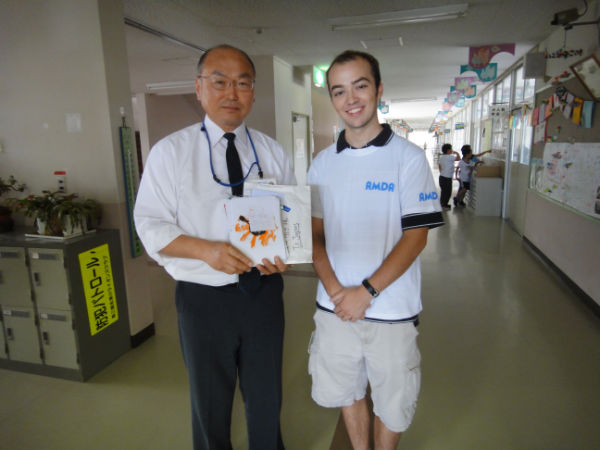
Shizukawa Elemetary School Principle Mr Kai-ichi Kato and James Buttenheim - AMDA giving cards written by children of a school in B.C, Canada
 I hope this message finds you in good spirits and with weather much less humid than here in Japan. My name is James Buttenheim, and I am an American college student working as an intern for AMDA this summer. I had the honor and privilege to personally deliver the letters from Roy Stibbs elementary school to the principal of Shizukawa elementary school.

I want to thank you for this kind, simple gesture to the Minamisanriku community. Since the school has just recently begun operating normally again and is now trying to make up for lost time, the principal, staff, and students find themselves extremely busy each day. Therefore, we were not able to see the cards distributed to the students. However, the principal was pleased to accept them, and I know these letters will brighten the students’ day when they receive them.

Additionally, the sentiment will show the families of this community that the larger world community cares about and is with Japan during this trying time.

As you may or may not know, one of our upcoming events in August will be a week of soccer matches. Middle school soccer clubs from various towns in Tohoku will get the chance to meet their peers in Okayama and build new friendships. During this past week, among other things, we met with some of the middle school soccer clubs that will be joining us in Okayama.

After meeting Principal Kato, we traveled to Shizukawa middle school, and on Thursday we met the Otsuchi team. However, most of the week was dedicated to visiting various shelters and field hospitals and distributing medicine and new supplies.

On Tuesday, while we were in Minamisanriku, Ms. Tae Namba, Ms. Tomoko Ohmasa and I met with doctors at the Shizukawa hospital. On Wednesday, our team traveled to Daitokuin Temple and Otsuchi High School which are now doubling as shelters. At Otsuchi High School, we also met with a newly formed branch, AMDA’s Otsuchi club. High school students from this club will visit Okayama this month to meet AMDA’s Okayama club.

On Thursday morning, Ms. Ohmasa and I visited a nursing home in Otsuchi and several other shelters to deliver the remaining supplies.

Saturday, July 2, 2011

Rose Charities Penang, Malaysia, upcoming events, programs and plans..

George Town, Penang, from Penang Hill
Grand Charity Concert:   On 12 sept.2011 , Rose will organise a grand charity concert under the theme " Mid Autumn Festival " celebrations at the State Auditorium. An organising committee chaired by Mr Lawrence Cheah (Hon Chair of Rose Charities Malaysia)  has been set up to plan and organise the big musical event. The Governor of Penang and his consort, the Chief minister of Penang and state VIPS will be among a capacity crowd of 1,200 invited guests at the 2 hour variety musical performance. The concert will feature cultural dances from various groups in penang, musical singing groups,ballet dances,a 120 strong chinese orchestra, etc...Proceeds from the concert will be donated to various needy organisations and the proposed setting up of an eye clinic under ROSE. The festival is organised by ROSE with the endorsement from the Penang state government , the penang arts council , and various cultural bodies in penang .

Rose Charities International Meeting: March 2012:   For the  2012 ROSE Conference here , an organising committee is being set up to plan and organise the 4-day international confeerence .from 15 to 18 March 2012 at the Paradise Sandy Resort Hotel . Proposed 4 day programme still on planning stage and will be submitted to the board for consideration and approval. .

Upcoming activities:  Among the up coming activities and projects will be..
  •  3 day Bukit Mertajam Health EXPO from 22 to 24 July '; 
  • one-day trip to Pulau Aman for ROSE members on 9th july' 
  • 3 day trip to Orang Asli settlement in Cameron Highlands from 9 to 11 oct.2011...Participating groups from the lions clubs,health ministry ,family planning association, Senior citizens grouops and ROSE will  assist in organizing

Rose Charities Vietnam: Update: July 2011

A new home for a family with special needs
Rose Charities Vietnam: Update: July 2011  (from Ms Thuc - Rose Vietnam)

Rose Charities Vietnam: Update: July 2011 (from Ms Thuc - Rose Vietnam) 

Rose Vietnam is in the hands of a small team of extraordinarily dedicated volunteers, Mr. Nguyen Chi Phuoc and Ms. Hanh Thuc Thanh (Thuc). 

Currently Rose Vietnam is focusing efforts in Hue, where there is a great deal of poverty compounded by frequent typhoons and flooding. Projects in Hue include a school for blind adults, building ten houses for very poor blind people (4 completed to date, each house costs approximately $2000), education support and income-generating projects. 

Here is a summary of a case study recently completed in Vietnam 

“ Vietnam which has more than 3000 km of coastal line is received with many tropical storms from East Sea every year. Storms of destructive nature causing considerable damage, generally, strike the central part of Vietnam; namely three provinces, HaTinh, ThuaThienHue and QuangNam. Particularly, in Hue, since 1999, hundreds of people have lost their lives and the property damage comes amounts to thousands of billions Vietnam dong. 

Last month Thuc made a trip to Hue, with Mr. Phuc, and sent back the following report. We rely heavily on these reports from the field: this one is submitted (almost) verbatim to demonstrate the cultural challenges, difficult choices that have to be made when allocating scarce funds and the dedication of Mr. Phuc and Ms. Thuc. 

Day 1: Visited two finished houses. To date four houses have been built. 

Visited two families who may qualify for sponsorship from Rose Vietnam for a house for shelter. It was decided to accept one case and reject another one. Reason for rejection: The candidate is an old blind women who has 2 daughters. The younger daughter is mentally challenged and lives with the mother, the second daughter is married and lives in a house with her husband and in-laws. Her husband does not want the mother and younger daughter to live with them due to the daughter’s mental illness. The woman’s younger brother lives in the same neighbourhood in his own house. He doesn’t want his sister and his niece living with him because his house is a remembrance building for ancestors and women are not allow to sleep there. This nonsense tradition and the unequal treatment toward the old blind woman and her daughter with mental problem are the sources of the tragedy. We want to create pressure on the family and local society. Good traditions should be kept to inspire morality and ethics. Nonsense traditions should be eliminated. Thus, the family should make the arrangements for these two poor women and the local society should redefine the standard in evaluating children's duties and compliance toward previous generations. 

We visited one on-going building site: this house is being built with 20 million VND, which was donated by the Canadian Community in Ho Chi Minh City.   The house will provide a decent shelter for a very poor elderly lady and her daughter, who has a mental problem. The daughter collects plastic from trash everyday for a living. Their house is on the bank of a river. Since it is not permitted to have house in this area which is considered as high risk during the flooding period the local authority granted land for her. But she needs some money to build a house. A representative of a local government organization will give her an additional 10 million VND (Vietnam dong; about Cdn $468).

I have learnt that all the houses built by Rose Vietnam have received contributions not only from CanCham and PEB Steel but also from local authorities and neighbours. This is such a wonderful thing. Phong Dien Blind Associate have referred cases to us and we will select the most needy. Mr. Phuoc has done a great job in the effort of coordinating with Phong Dien Blind Associate. He has great understanding of the local mindset. My concern is that we normally give the money after the house is built; we do cash giving. I guess this is the best that we can do. 

Day 2: Thanh Tien village 

This is Mr. Phuoc’s hometown. Mr. Phuoc knows most everyone and has a deep connection with this place. This village is among the poorest villages in Hue. Thus, the villagers have a hard time maintaining a common place for ceremonies and public usage. Mr. Hoa (chief of the village) has sought help from Rose. So far, Rose Vietnam has supported repairs for the main house in the complex with a budget of 10 mil. VND. There are two rooms in the house. One is used to teach the villagers making paper flowers and another room is used as classroom. 

The key persons of the village would like Rose to consider 3 project proposals: 

1) Investing in a sewing programme to create jobs for young women in Thanh Tien. Many young people are leaving the village to move to the booming metropolis. Mr. Phuc feels the urge to build a strong economy in the village. He buys trash from clothing manufactures, which is separated into two groups, paper and small pieces of cloth. The paper is then sold to a recycling depot and the pieces of cloth are used to make rugs/bath mats. 

2) Supporting an encouraging education fund for the village. 

3) Supporting the effort to maintain a traditional art and income opportunity which is paper flower creation. Please visit this website to understand it: 

Mr. Hoa (the artist) is also the chief of Thanh Tien village. Although this art does get public interest it hasn't received sufficient financial support to survive. Each lotus flower is sold for 8,000 VND (37 cents). A tourist who wants to learn to make one is charged only 30,000 VND ($1.40). 

Recommendations: 

~While the recycling idea is a good one the sewing industry in Vietnam is very competitive. I told Mr. Hoa that I appreciate the thought of job creation for female villagers but I wish he would change his mind and focus in Thanh Tien’s competitive advantage. Working together in the paper flower business is an idea. Thanh Tien can become a tourist destination and promote traditional art. 

~Supporting an encouraging education fund: I think a sufficient fund for an excellent and strong minded student who comes from disadvantage family and tries hard to be the best at school is crucial. I recommend that four candidates submit papers including school record for a year and a certificate to prove that he/she belongs to a disadvantage family (Vietnamese government gives a certificate for disadvantage household so that they can collect social welfare; this amount is very little). A decision would be made based on these submissions. 

~Paper flower creation: I recommend Rose Vietnam grants Mr. Hoa 1.5 mil VND for the copyright registration fees. There is a need to furnish the making paper flower teaching room. Mr. Phuoc can advise us the cost. Something basic and organic feeling is a way to go; tourists come from the city and they love the simplicity of the countryside. I would like to see it turned to a real classroom and an exhibition place so that tourist can visit there. I asked Mr. Hoa about growing more plants and removing weeds to make it more attractive.

Tuesday, May 10, 2011

Brighter Smiles Africa team for 2011

The 2011 Brighter Smiles team arrives in Kampala in mid June for 4 weeks collaboration with students and faculty from Makerere University. Drea, Lawrance, Mo and Najia are Canadian medical and dental students from Vancouver and Prince George who will go the the community schools that are part of the Brighter Smiles program in Uganda, to deliver this year’s health promotion updates and conduct the annual examination and follow up of all the participating children.

Saturday, May 7, 2011

AMDA Japan Tohoku Tsunami March 2011. Activity Report. 7 May 2011

(2011-05-06)

Overview:

Mar. 11: In response to the catastrophic earthquake and tsunami that struck the northeast of Japan, AMDA decided to dispatch its first emergency relief team.

Mar. 12: AMDA team left for severely hit Sendai City in Miyagi Prefecture and started to deliver medical assistance.

Mar. 15: While part of the team remained in Miyagi, the rest relocated to Kamaishi City and Ohtsuchicho in Iwate Pref. and initiated relief work.

Mar. 19: In response to the request from the worst hit Minamisanriki-cho (Miyagi), AMDA dispatched its relief team to provide medical relief.

Mar. 21: The work in Sendai (Miyagi) was completed (transferred to a local body.)

Mar. 31: The work in Kamaishi (Iwate) was completed (transferred to a local doctors¡Ç association.)

Apr. 20: The work in Minamisanriku-cho (Miyagi) and Ohtsuchicho (Iwate) were completed. While the activities were handed over to local bodies, services such as acupuncture therapy and health assistance have been continued.


Total number of AMDA's relief personnel (as of Apr. 26th): 148

51 doctors, 33 nurses, 4 midwives, 2 assistant nurses, 3 pharmacists, 2 psychotherapists, 49 coordinators, 2 careworkers, 2 acupuncture therapists


Besides direct medical assistance, AMDA responded to various local needs such as setting up a playroom for children in the evacuation shelters, holding recreational events and nutrition programs as well as providing meals.

In line with the dispatch of medical teams, AMDA sent aid supplies using the hearty funds from its donors all around the world. The relief goods were prepared in response to the request from the local teams and were delivered seven times in total using a chartered-truck. Commercial delivery services were also used after they resumed their regular operations in the devastated regions. The goods included medical supplies, medical devices (electrocardiogram and ultrasound machines), food supplies (rice, vegetables), daily life goods, bicycles, stationery and appliances (washing machines, computers, batter chargers etc.)


The daily operations at the activity sites:

While AMDA teams were stationed at evacuation centers, the teams delivered mobile clinic services to homes and smaller (remote) evacuation shelters in the respective regions. There were far more numbers of patients with stress- related ailments and chronic diseases than those that needed surgical treatments.


Due to the stagnant recovery of lifelines, sanitary conditions got worsened which later developed into the outbreak of norovirus. However, various counter measures such as isolation of infected individuals, thorough sanitization efforts and awareness promotion have succeeded in halting the spread of the disease.

In addition, AMDA sent psychiatrists to help the evacuees that were fatigued both physically and mentally from prolonged evacuation life, and extended a helping hand to those who had been suffering from mental illnesses.

Besides incorporating acupuncture therapy in its services, AMDA also distributed life goods upon mobile clinic services.

In securing the privacy among evacuees in the shelters, AMDA provided partitions for each household, and also sent a medical trailer equipped with individual compartments.


Further scope of assistance:

In line with the recovery of local healthcare systems, AMDA will extend its assistance in the rehabilitation phase. In addition to ongoing acupuncture treatments and health support measures, AMDA will contribute to the rebuilding of local hospitals/medical institutions and provide medical personnel if needed.

AMDA has also set up a three-year scholarship program, starting this year, to back up high school students in the regions (Kamaishi High School, Ohtsuchi High School, Shizugawa High School) who wish to work in the medical field in the future.

Furthermore, a plan is underway for this summer to hold a sport-exchange event, inviting junior high school students from disaster areas to Okayama (home to AMDA). The event hopes to promote mutual understanding and friendship between students from Okayama and those from disaster areas who persevered the hardship.

Saturday, April 2, 2011

'Hands up for Africa' welcomed as new RC Canada member project

A big welcome to the wonderful 'Hands up for Africa Group' and their projects in Kenya. The projects are in a education, clean water, agriculture and orphanage in an impoverished  community S.W. of Nairobi. (Kadjiado) Hands up for Africa and Rose Charities are natural partners as both focus on ground level cost effective help to communities with zero administration costs.   Hands up for Africa, join an expanding Rose Charities African group of member projects, currently including sites in Uganda, Rwanda, Madagascar, Zambia  and Kenya.